Turn your mortgage into a wealth-building tool. Smith Manoeuvre strategies, tax-smart planning, and honest math from two Canadian mortgage strategists.
Kelowna Ranks First for Wildfire Risk in Canada: What Condo Buyers Need to Understand Before Closing
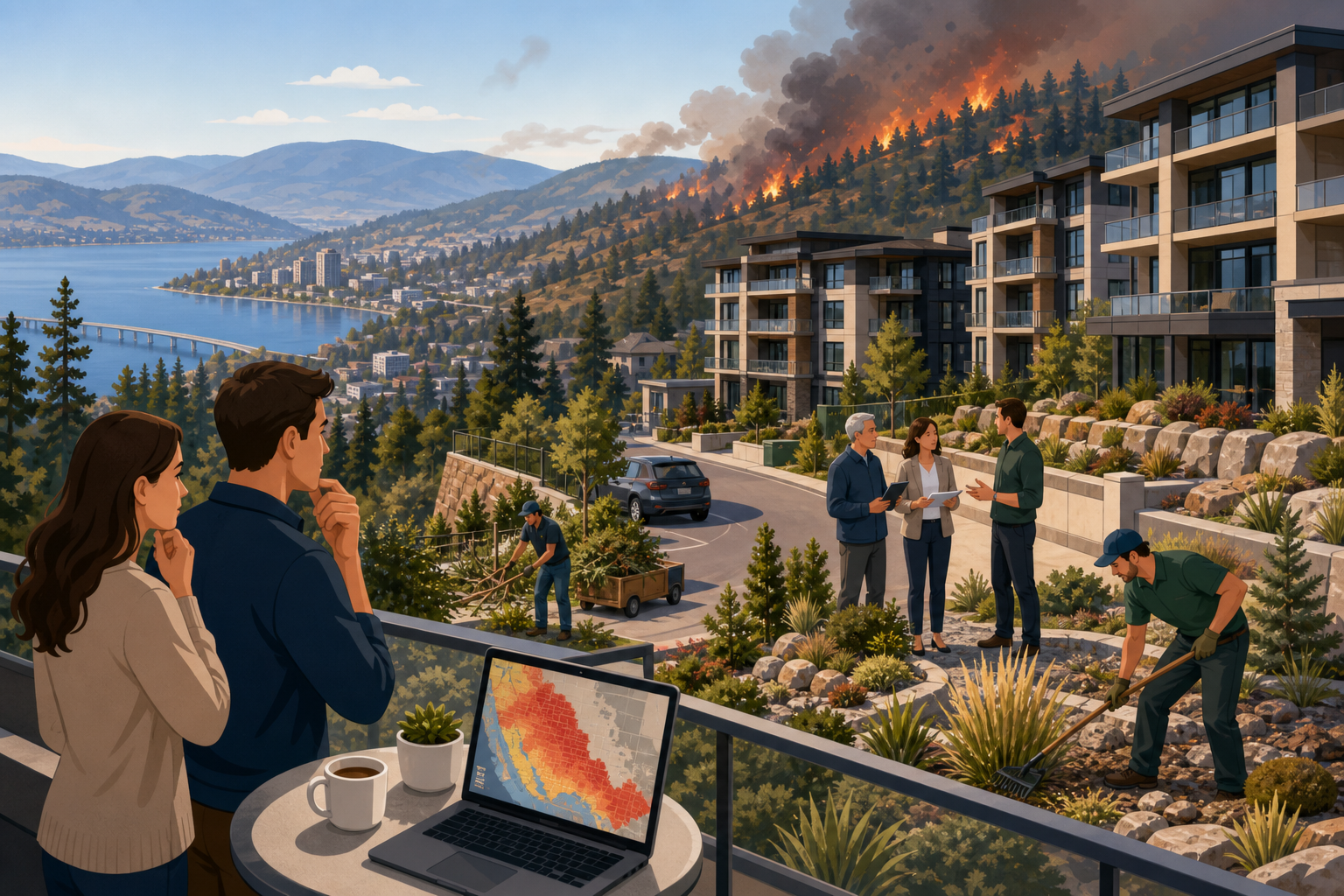
The City of Kelowna sent out 489 evacuation notices during the McDougall Creek wildfire in August 2023, most of them to hillside condo developments built within the last fifteen years. The buildings themselves didn't burn, concrete and steel hold up well against embers, but the insurance premiums started climbing within six months, and they haven't stopped.
Natural Resources Canada's 2026 risk assessment ranks Kelowna as the highest wildfire-risk city in the country, using upgraded geospatial forecasting that maps fuel loads, slope angles, and historical wind patterns at a neighbourhood level. For condo buyers, the ranking is less relevant than what insurers do with the data. The real exposure isn't whether your building catches fire. It's whether the strata corporation can still afford to insure it.
The Insurance Cliff Is the Actual Risk
Strata insurance in the Okanagan has entered a different pricing regime. Buildings in designated high-risk zones, particularly those near provincial parks or on south-facing slopes where fuel dries faster, are seeing renewal premiums rise 15 to 25 percent year over year. Some buildings now carry deductibles of $250,000 or more for wildfire-related claims, a cost that gets split among all owners if a loss occurs.
The problem compounds when you try to sell. A buyer's lender will review the strata's insurance coverage during the mortgage approval process. If the deductible is high enough or the policy has been non-renewed, the lender can decline the file outright. You might own a pristine two-bedroom with granite countertops and mountain views, but if the building's insurance is flagged, your equity is illiquid.
What "Wildland-Urban Interface" Means for Your Money
Kelowna's geography puts most new condo developments in what fire scientists call the Wildland-Urban Interface: residential zones that abut forest or grassland. The WUI designation shows up on municipal hazard maps, and those maps are now being shared during real estate transactions in BC with increasing frequency.
A proactive Strata Council treats the WUI designation as a maintenance issue, not a marketing problem. Buildings that invest in FireSmart landscaping, removing cedar hedges, replacing wood mulch with rock, thinning fuel loads on common property, can sometimes negotiate better insurance terms. Over 500 communities in BC are pursuing FireSmart recognition, which signals to insurers that the risk is being actively managed rather than ignored.
The City of Kelowna offers cost-share programs for strata corporations willing to do fuel reduction work, but take-up has been uneven. Some councils see it as an expense. Others see it as the difference between a building that stays insurable and one that doesn't.
Air Quality as a Yield Problem
Beyond the direct fire risk, Kelowna's smoke season has become a quantifiable drag on short-term rental income. Properties marketed to tourists see booking cancellations during multi-week smoke events, and those cancellations show up in rental yield calculations when investors run their numbers.
For owner-occupiers, the smoke season is a lifestyle consideration. For investors treating the condo as an income property, it's a cash flow problem that recurs every summer and may worsen under current climate projections.
Construction Resilience Cuts Both Ways
Modern mid-rise and high-rise condos are structurally more resilient to wildfire than wood-frame detached homes. Concrete doesn't ignite from ember showers. But resilience at the building level doesn't eliminate exposure at the strata level. The risk has moved from "will this building burn down" to "will this building remain financially viable to own."
Before you firm up an offer on a Kelowna condo, request three years of strata insurance history, not just the current policy. Look at the deductible trend and the premium escalation. Ask whether the building has completed a FireSmart assessment. Check the City's Community Wildfire Resiliency Plan to see where the property sits on the hazard map.
The ranking matters because it reflects what insurers are already pricing in. It won't show up in the listing photos, but it will show up in your monthly strata fees, and it might show up when you try to sell.



The City of Kelowna sent out 489 evacuation notices during the McDougall Creek wildfire in August 2023, most of them to hillside condo developments built within the last fifteen years. The buildings themselves didn't burn, concrete and steel hold up well against embers, but the insurance premiums started climbing within six months, and they haven't stopped.
Natural Resources Canada's 2026 risk assessment ranks Kelowna as the highest wildfire-risk city in the country, using upgraded geospatial forecasting that maps fuel loads, slope angles, and historical wind patterns at a neighbourhood level. For condo buyers, the ranking is less relevant than what insurers do with the data. The real exposure isn't whether your building catches fire. It's whether the strata corporation can still afford to insure it.
The Insurance Cliff Is the Actual Risk
Strata insurance in the Okanagan has entered a different pricing regime. Buildings in designated high-risk zones, particularly those near provincial parks or on south-facing slopes where fuel dries faster, are seeing renewal premiums rise 15 to 25 percent year over year. Some buildings now carry deductibles of $250,000 or more for wildfire-related claims, a cost that gets split among all owners if a loss occurs.
The problem compounds when you try to sell. A buyer's lender will review the strata's insurance coverage during the mortgage approval process. If the deductible is high enough or the policy has been non-renewed, the lender can decline the file outright. You might own a pristine two-bedroom with granite countertops and mountain views, but if the building's insurance is flagged, your equity is illiquid.
What "Wildland-Urban Interface" Means for Your Money
Kelowna's geography puts most new condo developments in what fire scientists call the Wildland-Urban Interface: residential zones that abut forest or grassland. The WUI designation shows up on municipal hazard maps, and those maps are now being shared during real estate transactions in BC with increasing frequency.
A proactive Strata Council treats the WUI designation as a maintenance issue, not a marketing problem. Buildings that invest in FireSmart landscaping, removing cedar hedges, replacing wood mulch with rock, thinning fuel loads on common property, can sometimes negotiate better insurance terms. Over 500 communities in BC are pursuing FireSmart recognition, which signals to insurers that the risk is being actively managed rather than ignored.
The City of Kelowna offers cost-share programs for strata corporations willing to do fuel reduction work, but take-up has been uneven. Some councils see it as an expense. Others see it as the difference between a building that stays insurable and one that doesn't.
Air Quality as a Yield Problem
Beyond the direct fire risk, Kelowna's smoke season has become a quantifiable drag on short-term rental income. Properties marketed to tourists see booking cancellations during multi-week smoke events, and those cancellations show up in rental yield calculations when investors run their numbers.
For owner-occupiers, the smoke season is a lifestyle consideration. For investors treating the condo as an income property, it's a cash flow problem that recurs every summer and may worsen under current climate projections.
Construction Resilience Cuts Both Ways
Modern mid-rise and high-rise condos are structurally more resilient to wildfire than wood-frame detached homes. Concrete doesn't ignite from ember showers. But resilience at the building level doesn't eliminate exposure at the strata level. The risk has moved from "will this building burn down" to "will this building remain financially viable to own."
Before you firm up an offer on a Kelowna condo, request three years of strata insurance history, not just the current policy. Look at the deductible trend and the premium escalation. Ask whether the building has completed a FireSmart assessment. Check the City's Community Wildfire Resiliency Plan to see where the property sits on the hazard map.
The ranking matters because it reflects what insurers are already pricing in. It won't show up in the listing photos, but it will show up in your monthly strata fees, and it might show up when you try to sell.
Read Next
Realtors Are Walking Away, And the Prenup Surge Tells You Why
Realtors Are Leaving the Industry, and the Numbers Tell You Why
Kelowna Now Ranks First in Canada for Wildfire Risk: What Condo Buyers Need to Verify Before Closing
TMX's $800-Million MEMX Deal Signals the End of Its Canada-First Strategy